In short: there is no single correct way to estimate work. This article sets out twelve common methods, from measuring, comparing and breaking work down to ranges, pilots and expert judgement, with when each is useful and what to watch out for. The skill is not producing a number. It is knowing how the number was created.
It is a question I have been asked more times than I can remember.
And no. Before anyone gets carried away, this is about estimating work.
Sooner or later, someone will ask you to size a piece of work. It might be a new system, a factory extension, an office move, an event, a business transformation, a new process, or even decorating the spare room.
The questions are usually the same. How big is it? How long will it take? Sometimes followed quickly by: can I have an answer by tomorrow?
That is the moment estimation begins. Not guessing. Estimating.
The interesting thing is that there is not one correct way to estimate. Most of us use several methods without even realising it. Sometimes we measure, compare, ask someone experienced, break the work into smaller pieces, use past data, or trust our judgement.
The skill is not just producing a number. The skill is knowing how that number was created.
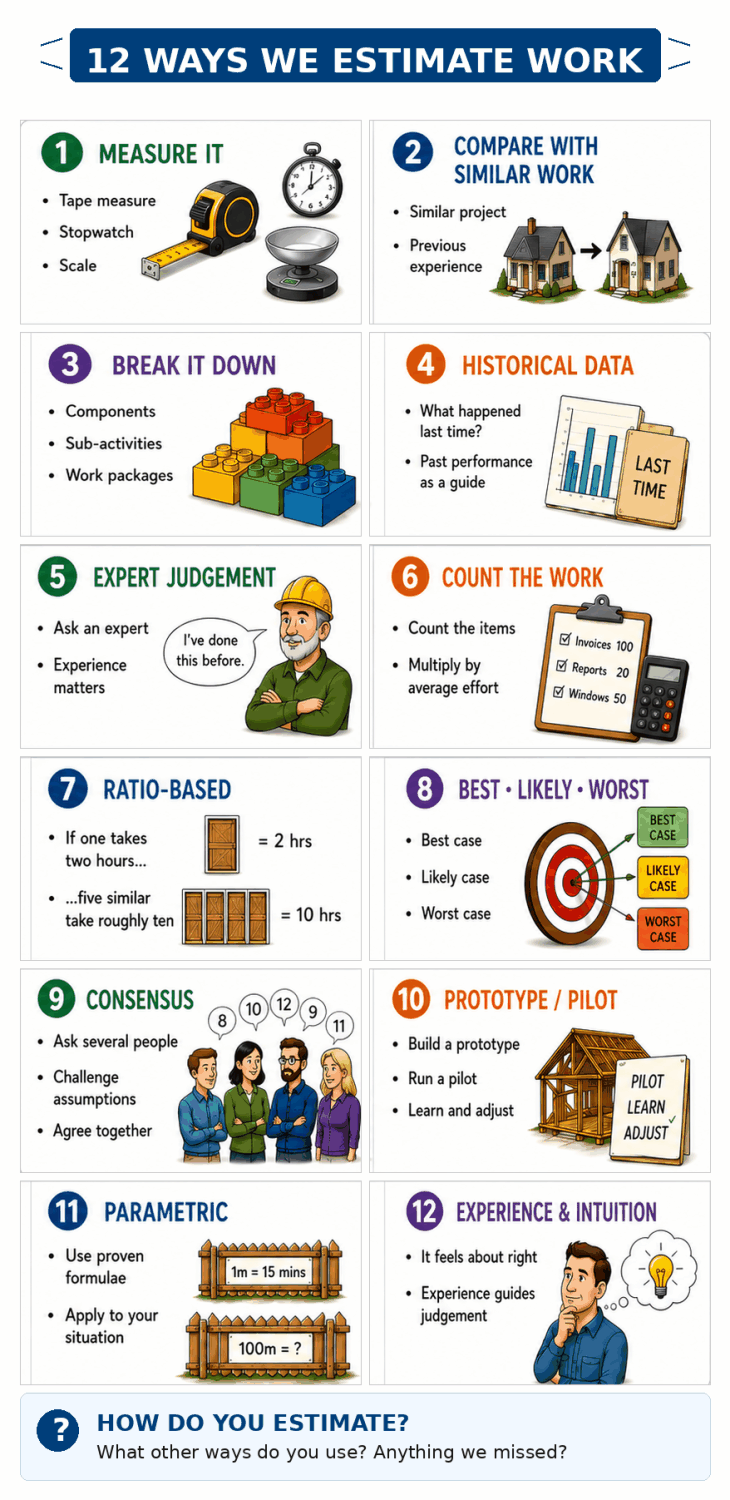
So here are twelve common ways we estimate work.
1. Measure it
The most direct approach. Use a tape measure, a stopwatch, a scale, or a count of what is actually there. But even measurement needs context. Are we measuring the whole job, or only the visible bit?
Useful when: the work is clear and observable.
Watch out for: hidden work, assumptions and missing scope.
2. Compare it with similar work
We did something like this last year. It can work well when the previous work is genuinely similar. But that is the important word: similar. Not vaguely familiar. Not the same shape from a distance.
Projects are a bit like garden sheds. From the outside, they all look simple. Until you open the door.
Useful when: there is a genuine previous example.
Watch out for: assuming two pieces of work are the same when they only look similar.
3. Break it down
Estimating the whole thing can feel impossible, so break it into smaller parts. Instead of estimating the house, estimate foundations, walls, roof, windows, services and decoration. Then add the parts together. This is often where hidden work starts to appear.
Useful when: the work has clear components.
Watch out for: forgetting integration, handovers and dependencies between the parts.
4. Use historical data
What happened last time? Past performance does not guarantee the future, but it is usually better than starting with a blank sheet of paper and a hopeful expression. Historical data can show how long similar work actually took, where delays appeared, what was underestimated and what was forgotten. Not how long people wished it had taken.
Useful when: records exist and the work is repeatable.
Watch out for: poor data, old assumptions and selective memory.
5. Ask an expert
Sometimes the quickest route to a realistic estimate is asking someone who has done it before. An expert will often spot dependencies, constraints, risks, waiting time, and the awkward bit nobody put in the first draft. Experience matters, especially when the work is messy, uncertain or full of we will work that out later.
Useful when: the work is complex or unfamiliar.
Watch out for: the confidence of one expert becoming the commitment of everyone else.
6. Count the work
Sometimes estimating starts with counting. A hundred invoices, twenty reports, fifty windows, two hundred users. Then multiply by the average effort. Simple and effective when the work is repeatable. The risk is assuming every item takes the same amount of time. It rarely does. There is always one invoice, one window or one user that decides to become a small project in its own right.
Useful when: the work is repeatable and countable.
Watch out for: outliers, exceptions and simple items that are not simple at all.
7. Use ratios
If one room takes two hours to paint, five similar rooms might take about ten. That can work when the relationship is stable. But ratios are dangerous when the assumptions change. Five rooms may not equal five times the effort if one room is full of furniture, damp, cables, people, approvals, or just one more small change.
Useful when: the work scales predictably.
Watch out for: assuming effort increases in a straight line.
8. Estimate a range
A range is often more honest than one fixed number too early. Think in terms of best case, likely case and worst case. A single estimate can sound precise. A range shows uncertainty. And uncertainty is usually where the truth is hiding.
Useful when: the work is uncertain or early-stage.
Watch out for: people hearing only the lowest number.
9. Build a consensus
Ask several people. Compare their assumptions, challenge the differences, agree a shared view. The conversation often matters more than the number. One person is estimating build. Another is thinking about testing. Another about business readiness. Another is wondering who is actually available to do any of it. All useful. All different.
Useful when: several teams or disciplines are involved.
Watch out for: false agreement because nobody wants to challenge the room.
10. Try one first
Sometimes the best way to estimate is to stop talking about the thing and try doing a small part of it. Build a prototype, run a pilot, complete one example, learn from it, estimate the rest. Reality is a very good teacher. Occasionally rude. But usually accurate.
Useful when: the work is new, uncertain or poorly understood.
Watch out for: treating the pilot as fully representative when it was the easy bit.
11. Use a formula
If one metre of fencing takes fifteen minutes, then a hundred metres gives you a starting point. Construction, manufacturing and engineering estimate this way all the time. It works well when the rates, quantities and inputs are known. Less well when half the inputs are still labelled TBC.
Useful when: rates and quantities are known.
Watch out for: weak inputs creating confident nonsense.
12. Use experience and intuition
It feels about right. We all do it. Sometimes intuition is just guessing. Sometimes it is years of experience working quietly in the background. The difficult part is knowing which one it is. A good instinct can be valuable. But it should still be challenged, especially if the estimate is being used to make promises, commit budget, set expectations or agree delivery dates.
Useful when: experience is deep and the context is familiar.
Watch out for: optimism dressed up as judgement.
Summary
No single method is perfect. Good estimators do not rely on one technique. They choose the right method for the situation, and they understand what is included, what is excluded, what assumptions have been made, and where the uncertainty still sits.
That is why the better question is not always how long will it take. Sometimes the better question is: how have we estimated it? Because the method matters.
Estimating the work is only part of planning. The activities still need to be connected through dependencies. Otherwise the project plan may remain little more than a task list, which is the subject of a separate article.
The twelve methods as a quick reference, for the next time someone asks how long it will take.
If sizing and scoping is a live issue
The ERP and CRM Readiness Check covers people, process, technology, data and commercial readiness in seventeen questions, and the Payback Checker turns cost and benefit estimates into outline business case numbers as you type.
Use the Readiness Check Read the FAQ