
In short: business systems are only as good as the data they are given. The technology is the kettle and the data is the water. Duplicate records, missing details and contacts kept outside the system limit what any CRM, ERP or AI platform can deliver. The article ends with a five-minute test to run before buying another system.
Probably not.
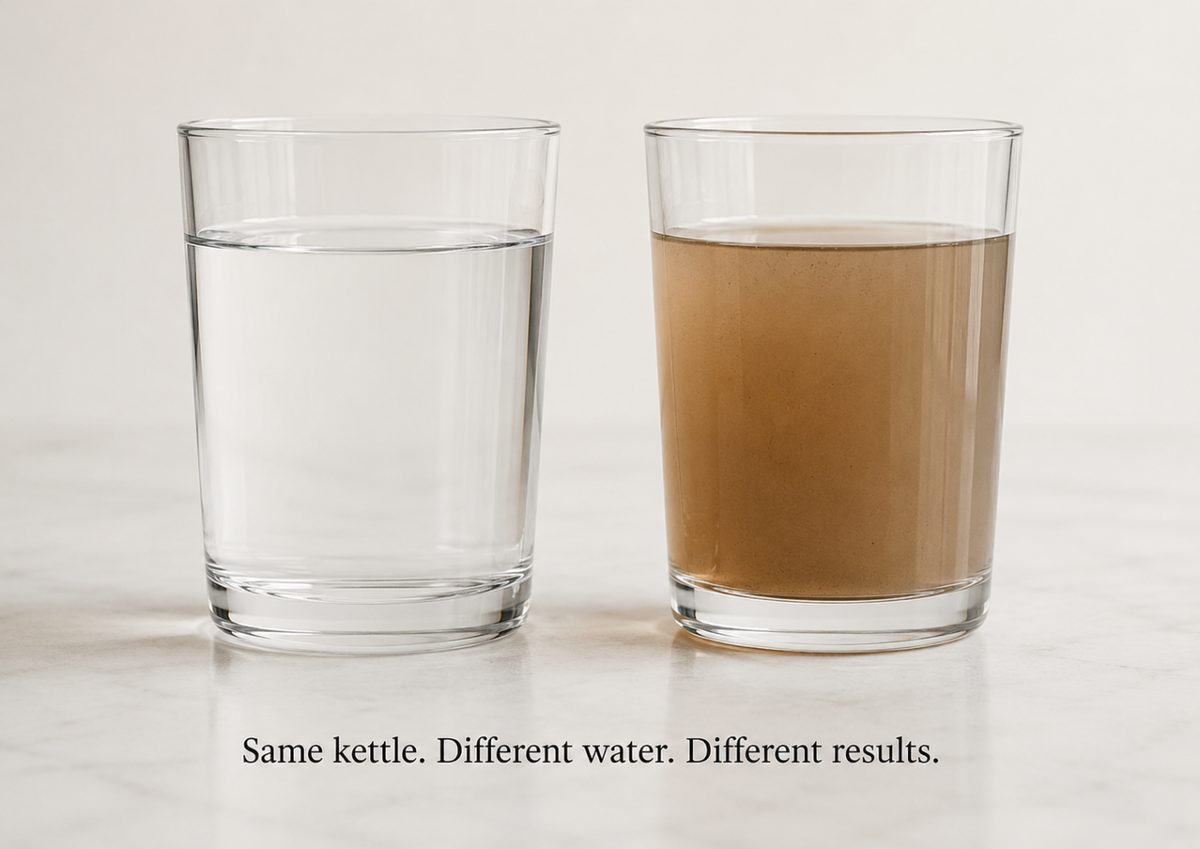
You already know what would happen. The tea would not taste right. If you kept doing it, the kettle would become dirty, clogged and unreliable. Eventually it would stop performing as it should.
You would not blame the kettle. You would blame the water.
Yet organisations spend hundreds of thousands, sometimes millions, on CRM, ERP, finance, HR, marketing and AI platforms, and then feed them the business equivalent of muddy water.
It is not really a technology problem
Business systems process data. CRM, ERP, finance, HR, marketing, business intelligence and AI platforms all depend on the quality of the information they are given.
The technology is simply the kettle. The data is the water.
What does muddy water look like?
Not literally muddy. Business muddy. By muddy water I mean dirty data. Things like:
- Duplicate customer records.
- Missing contact details.
- Suppliers entered twice.
- Product descriptions that do not match across systems.
- Out-of-date information.
- Data locked away in spreadsheets and workarounds.
- Workarounds nobody admits exist.
- It is all in my head.
None of those problems are caused by the software. The software simply inherits them.
The input matters
Imagine two organisations buying exactly the same CRM, ERP or business system. Same software. Same implementation partner. Same budget.
One spends time improving its data before migration. The other copies everything exactly as it is.
Six months later, one says: this system has transformed our business. The other says: the CRM does not work.
Did they really buy different software? Or did they simply pour different water into the kettle?
AI does not change the principle
AI can summarise, predict, recommend and analyse. It can also help identify duplicates, inconsistencies and missing information. But it still depends on the quality of what it receives.
It does not magically know which customer record is correct. It does not know whether three supplier records belong to the same company unless the business has rules for deciding that. It does not know that an address has not been updated for five years. It does not know that the spreadsheet on a desktop somewhere is more accurate than the official system.
AI does not remove the need for trusted data. It simply makes the quality of the data visible much faster.
Where does your sales data actually live?
Sales and customer data has its own version of muddy water. Often the problem is not dirty data in the system. It is data that never reaches the system at all.
- Little black books holding the contacts nobody else is allowed to see.
- Private spreadsheets kept on individual PCs.
- Offline trackers started with good intentions and since forgotten.
- “It is all in my head.”
There is usually a reason. A CRM asks sales people to share the contacts and relationships that earn their commission. If they are rewarded only for deals closed, recording the data will always be an afterthought.
That is where AI hits a wall. AI cannot read minds. It cannot scrape notebooks. It cannot fix data it cannot see.
I call these the two silent killers:
- NINI: No Input, No Intelligence. If customers and contacts never go into the CRM, AI has nothing to analyse.
- NANO: No Activity, No Outcome. Even when the customer is in the CRM, if the emails, calls, visits and bids are not recorded against them, there is nothing to learn from and no insight comes out.
Record them properly and AI can spot in seconds what used to take months. Ten bids and none won: time to rethink the offer. A 70% win rate but no follow-up: time to pick up the phone.
Same engine. Different fuel.
The kettle is a simple picture. A car engine is a better one for a CRM, because a CRM is meant to perform. Buy a new engine, run it on black books, spreadsheets and “it is all in my head”, and it struggles and splutters. Run the same engine on data that is captured, consistent and trusted, and it runs as it should. Sound on.
The five-minute kettle test
Before investing in more technology, ask:
- How many duplicate customer or supplier records do we have?
- Which reports are exported to Excel because people do not trust the system?
- How many records have missing key information?
- Which decisions are still based on someone knows the answer?
- Which customer contacts live only in a black book, a private spreadsheet or memory?
- Who owns the quality of each important data set?
- If AI answered a customer question today, would we trust the information behind its answer?
If those questions are difficult to answer, perhaps the water deserves attention before the kettle.
Better decisions begin with better information
Technology matters. But no system can consistently outperform the quality of the information it is given.
The kettle usually is not the problem. The water is.
Because better data does not just create better systems. It creates better business decisions.
This follows a wider principle: define the problem before choosing the change model or the technology. The FAQ covers what to check before signing an ERP or CRM contract, and data is first on the list.
Check the water before the kettle
The ERP and CRM Readiness Check includes data alongside people, process, technology and commercial readiness. Seventeen questions, five minutes, and an honest view of whether you are ready to shortlist suppliers or need to close gaps first.
Use the Readiness Check Read the FAQ