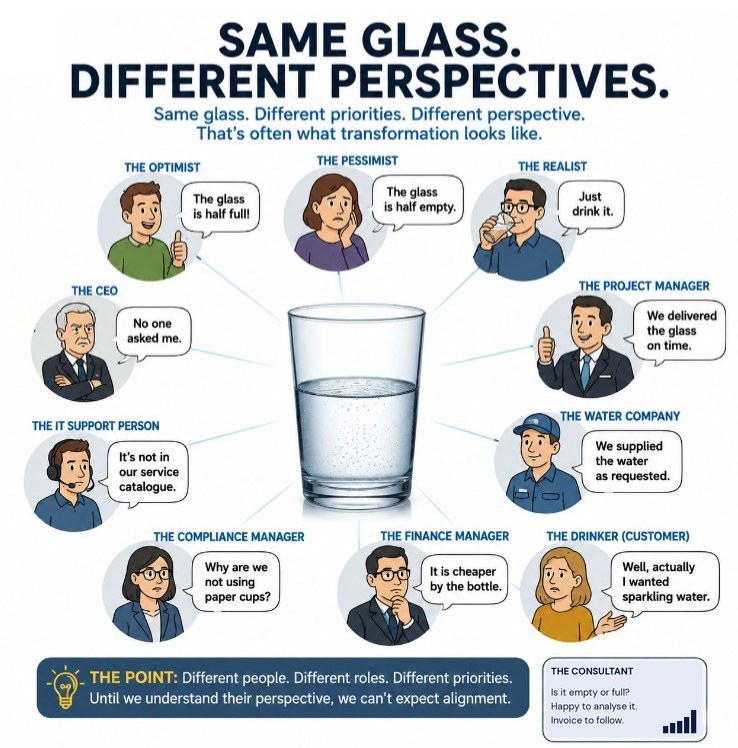
In short: everyone involved in a change can meet their own responsibility while the overall outcome still falls short. Different stakeholders see the same request differently, and each view usually has a reason. Ask what sits behind each request, separate what is essential from preference and habit, then bring the views together into a decision with an owner, and test it with the people who will use it.
One glass of water. Ten opinions.
The optimist says the glass is half full.
The pessimist says it is half empty.
The realist says just drink it.
The drinker, our customer, says they wanted sparkling water.
The water company says they supplied the water as requested.
The project manager says the glass was delivered on time.
The IT support person says it is not in the service catalogue.
The compliance manager asks why we are not using paper cups.
The finance manager says it is cheaper by the bottle.
The CEO says nobody asked me.
And, as a bonus, the consultant offers to analyse whether it is empty or full. There goes the drinks budget.
We all know the half-full, half-empty debate. But the other responses are where the business conversation gets interesting.
The supplier has delivered. The customer is disappointed.
The water arrived on time. It met the request. Someone may even have saved money.
Yet the person who wanted a drink is still looking for sparkling water.
Everyone can fulfil their own responsibility while the overall outcome falls short.
That is worth remembering when a project, programme or transformation is declared a success. Delivered against whose expectations? And did we understand those expectations before placing the order?
Why is the glass there in the first place?
When I originally shared this idea, Stuart asked exactly that.
A useful question. We can spend so long discussing the glass that we forget what problem it is supposed to solve.
Is someone thirsty? Are we testing the water? Is this a product demonstration?
John added that he wanted the water cold.
Another reasonable requirement. One nobody had mentioned.
Apparently, “a glass of water” was not quite the complete specification we thought it was.
More on this: The 6Ws: The Questions Every Change Programme Must Answer, starting with Why.
Different views can reveal something useful
People bring different responsibilities, experience and concerns to the same situation.
Finance needs to understand the cost. Compliance needs to check the rules. The supplier needs a clear request. Support needs to know what it will inherit. The customer needs something that meets their needs.
These concerns deserve a conversation.
Calling someone “resistant to change” tells us very little about what is worrying them.
Perhaps they have seen a similar change fail before. Perhaps the proposed process misses something they handle every day. Perhaps their team will inherit the extra work after everyone else has celebrated the launch.
You do not have to agree with every concern. You do need to understand it before deciding what to do.
The same thing happens with business processes
Imagine a business changing its ordering process.
- Sales wants to take orders quickly and give customers a delivery date.
- Finance wants the right prices, payment terms and credit checks.
- Operations wants accurate quantities and enough notice to plan the work.
- The supplier needs confirmed specifications and time to provide the materials.
- Customer service wants to know what was promised when the customer rings.
- The customer wants the right goods delivered when agreed.
All reasonable. But “make ordering easier” does not settle how those needs fit together.
Remove every check and Sales may gain speed while Finance gains a headache.
Add every possible check and the customer may lose patience before the order is accepted.
The useful discussion is about how the whole process should work, including the awkward orders that never appear in the demonstration.
Ask what sits behind the request
“I need this field to be mandatory.”
What goes wrong if it is left blank?
“I need a report every morning.”
What decision will it help you make?
“We cannot change that.”
What would happen if we did?
These questions help establish whether something is essential, a preference or a workaround for a problem elsewhere.
A legal requirement, an operational risk and “we have always done it that way” need different treatment.
Job titles alone will not tell you which one you are dealing with. Two people in the same role may have different concerns because their teams, customers or working conditions differ.
Listening still has to lead to a decision
Stakeholder management cannot stop at collecting opinions.
Someone needs to bring the competing needs together, explain the trade-offs and agree who makes the decision.
People should know what has been agreed, why, and what it means for their work. Any unresolved concern needs an owner and a next step.
Then try the process with the people who will actually use it.
A nod in a meeting is useful. Watching someone complete a real task tells you considerably more.
My experience across different businesses helps me recognise several views of the same glass. It also reminds me to ask about the view I have missed.
The quiet person at the end of the table may know exactly where it leaks.
Before declaring the glass delivered, check that the person who needs it can use it, that someone can support it, and that everyone understands what was agreed.
Otherwise, we could have a room full of people who have met their targets.
The question: Whose perspective do you tend to hear last, when it would have helped to hear it first?
Join the conversation on the original LinkedIn post, where readers added their own views of the glass.
Are your stakeholders engaged, or just nodding?
The Programme and Business Readiness Assessment tests sponsorship, stakeholder engagement and governance in thirteen questions, with your biggest gap and a next step for each. Free, and nothing is stored.
Take the Readiness Assessment Read the FAQ